
Dark Energu and Entanglement's Edge How the Universe Expands = DOC Predicts
DOC resolves the Hubble Tension and the Crisis in Cosmology. Thoretically Entanglement unfolds into the Spacetime. Philosp[hically the Universe tries to resolve it's own Incompleteness

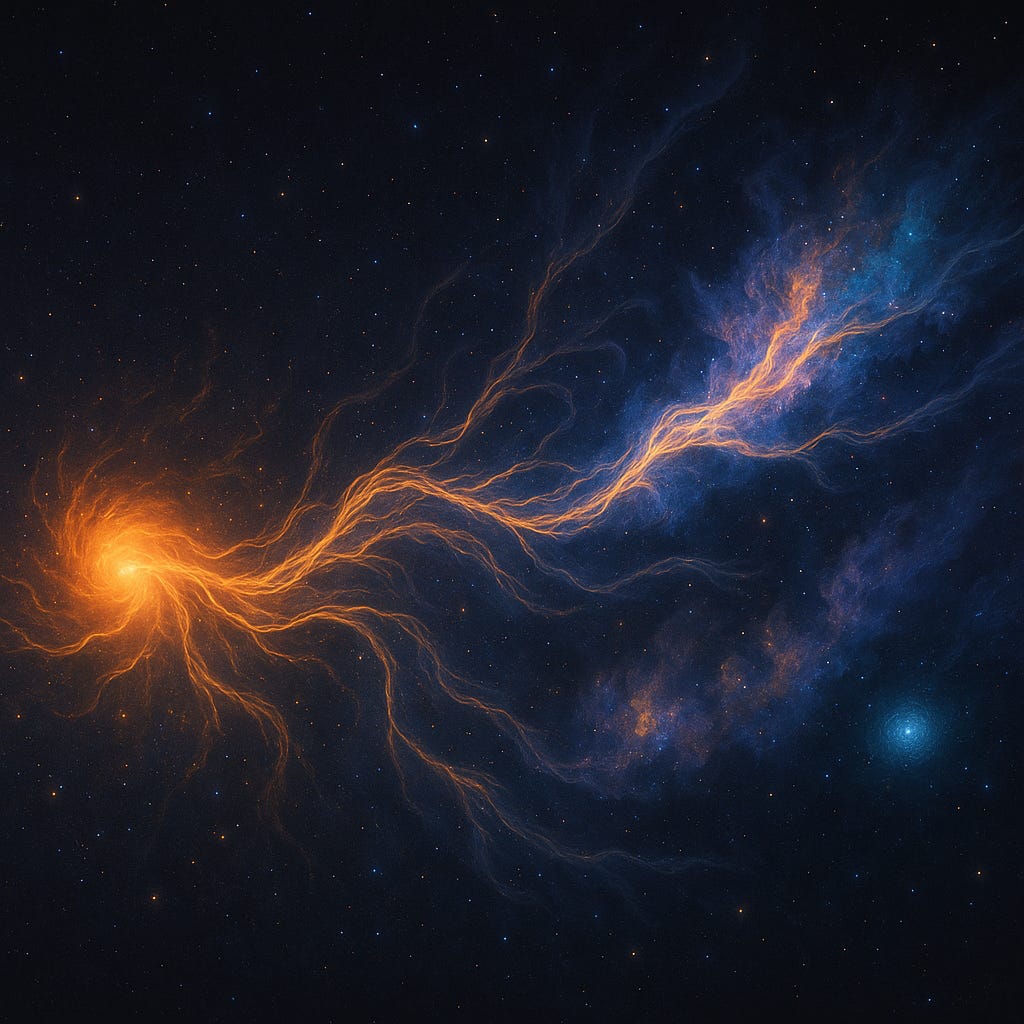
The universe expands, and in its expansion it unfolds—not as emptiness, but as entanglement, as a weaving of hidden threads into the very loom of space and time.
Every degree of freedom stretches outward, carrying with it the trace of all that came before, weaving entropy into the fabric of space as though the cosmos were composing a symphony from unresolved chords.
What we call dark energy is not mere absence, nor a static constant hanging in the equations. It is the pressure of incompleteness, the drive of a system that refuses to close its own account. Each new horizon that opens, each incremental swelling of volume, bears the echo of information still unsettled. These echoes ripple outward, carrying with them the memory of unfinished patterns.
The cosmos is not finished; it yearns toward equilibrium. Expansion is not only motion but also inquiry—a dialogue between what has been encoded and what remains undecided, between coherence and the shadow of coherence. The outward rush of galaxies is a kind of question posed to the void, and the structure of spacetime is the attempt at an answer. It is entanglement entropy translated into geometry, the unmeasured becoming measurable, the undefined becoming form.
Dark energy is the reminder that incompleteness cannot remain dormant. It stirs spacetime, compels it to move, to stretch, to keep rewriting itself in pursuit of a balance it has not yet found. It is both the imbalance and the attempt at resolution, both the wound and the act of healing.
Thus, the accelerating universe is not a riddle imposed from beyond, but a recursion generated from within—an unfolding that speaks of unfinished logic. The cosmos strives to complete itself, folding contradictions into larger coherence, embedding paradoxes into higher structures. In its acceleration we do not see an inexplicable force, but the universe remembering that it is incomplete, and in that incompleteness lies the inexhaustible source of its becoming.
Coherence, Dark Coherence, and Cosmic Acceleration
In the standard ΛCDM model, cosmic acceleration is attributed to a cosmological constant—an unchanging vacuum energy density added into Einstein’s field equations. While this approach is mathematically simple, it raises major theoretical challenges. The magnitude of the cosmological constant must be fine-tuned to an extreme degree compared to estimates from quantum field theory, creating the so‑called fine-tuning problem. In addition, ΛCDM struggles with the Hubble tension: early-universe estimates of the Hubble parameter from the cosmic microwave background are significantly lower than late-universe values inferred from supernovae and local distance measurements. These discrepancies suggest that cosmic acceleration may not be static but dynamically evolving.
The coherence–dark coherence framework provides an alternative explanation. It treats acceleration as the result of recursive field dynamics rather than a fixed constant. In this model, expansion is driven by two interacting components—real coherence energy and imaginary dark coherence energy—whose relative strengths change across cosmic time. The balance between these components produces alternating periods of suppression and resurgence in the rate of cosmic acceleration.
Coherence Energy (E_R)
The real coherence energy (E_R) dominates in the early universe. It acts as a regulator, keeping post-recombination expansion smooth and nearly uniform. By damping fluctuations, it helps stabilize the growth of large-scale structure. Without this stabilizing influence, the early universe would likely have developed chaotic instabilities that would disrupt galaxy formation. Coherence energy therefore functions as the organizing principle of the young cosmos.
Dark Coherence Energy (iE_I)
At later times, as the universe expands and matter becomes less dense, the imaginary dark coherence energy (iE_I) becomes more influential. Dark coherence couples only weakly to visible matter, but it dominates the late-time expansion dynamics. Its increasing contribution produces the acceleration observed at low redshifts. Unlike the static cosmological constant, dark coherence is dynamic, with strength tied to coherence length scales that shift as the universe dilutes. This naturally explains why acceleration is relatively weak at high redshift but stronger in the present epoch.
Entanglement Entropy and Incompleteness
A central idea in this framework is entanglement entropy—a measure of correlations between degrees of freedom across horizons. As the universe expands, the number of correlated degrees of freedom increases, embedding entropy into spacetime itself. Dark energy, in this interpretation, is not a fixed constant but a manifestation of unresolved correlations, or incompleteness. Expansion continues because these unresolved correlations act like pressure. The mismatch between encoded information and the geometry that contains it drives growth, making acceleration the natural unfolding of incompleteness into physical space.
Resolving the Hubble Tension
The framework also provides a way to resolve the Hubble tension. By incorporating coherence length scales into the Friedmann equations, natural suppression factors appear. At high redshift, real coherence dominates, lowering the effective Hubble parameter and matching early-universe observations. At low redshift, dark coherence dominates, increasing the expansion rate to match late-universe data. In this view, the Hubble tension is not a conflict but an expected outcome of recursive modulation between coherence and dark coherence fields.
Broader Implications
Dynamic Dark Energy: Acceleration is produced by evolving fields rather than a fixed cosmological constant.
Information-Theoretic Gravity: Expansion is connected to entropy growth and entanglement, making spacetime an information-processing system.
Observable Predictions: The model forecasts variability in late-time acceleration, modifications to structure growth rates, and scale-dependent signatures in large-scale galaxy surveys.
Quantum–Cosmology Link: The framework suggests a deep relationship between spacetime geometry and quantum entanglement, echoing holographic principles.
Conclusion
The coherence–dark coherence model reframes cosmic acceleration as a dynamic, entanglement-driven process. The universe expands not because of a fixed constant, but because incompleteness and unresolved correlations are built into its structure. Expansion becomes the geometric expression of entanglement entropy unfolding into spacetime. From this perspective, cosmic acceleration is not an unexplained anomaly but evidence of the universe striving toward coherence, encoding information, and transforming incompleteness into geometry.
Mathematical Framework
Modified Friedmann Equation with Coherence Terms
Evolution of Coherence Components
Suppression Factors from Coherence Lengths
Recalibrated Hubble Parameter
Click on the Zenodo link for the full description:
Coherence and Dark Coherence in Cosmic Evolution: Resolving Dark Energy and the Hubble Tension